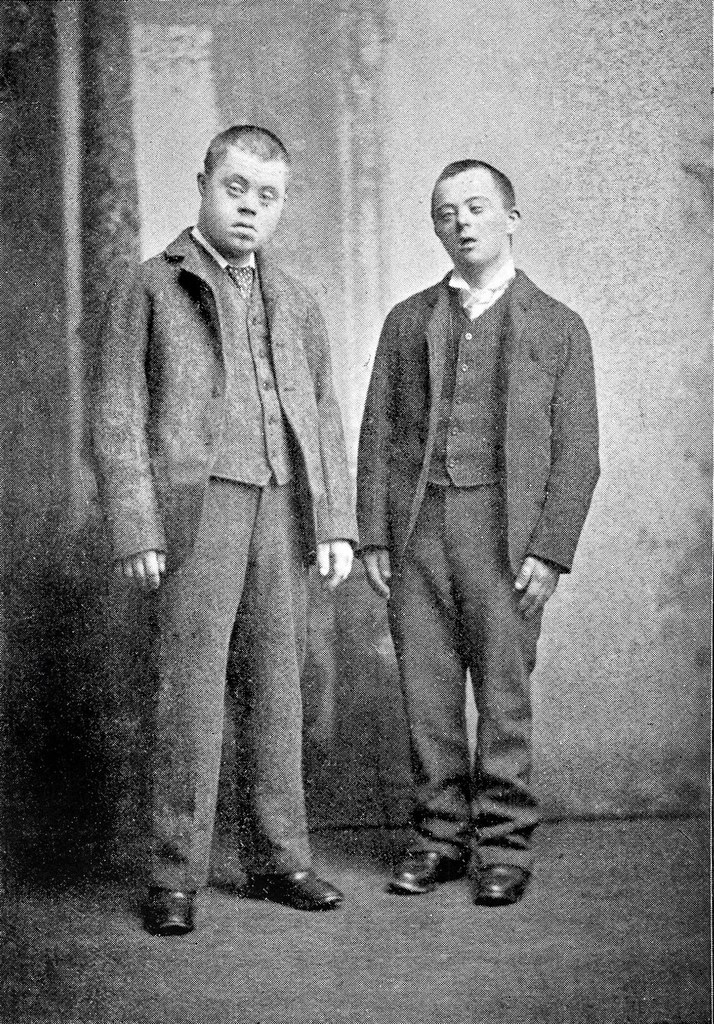
“I Love When Eugenics Is Readily Displayed on YouTube (Not)”

This YouTuber and his wife have stressed me out. But I have a lot of thoughts regarding their situation that I need to just put on this page so they don’t keep spinning around in my head.

I stand for women having full control of the choices in regard to their bodies. And I stand for women having adequate reproductive healthcare in all situations.

I’m also a disabled woman who was born that way. And I’m a special education teacher. And one day, I hope to be a mom.

In case you’re reading this and are confused, a well-known, well-off YouTuber and his wife were trying for a baby, got pregnant and were excited to have this baby. That is, until they went in for genetic testing, and discovered that their baby would be born with Down Syndrome. They terminated the pregnancy.

Down Syndrome is the name given to Trisomy 21. It’s a genetic mutation which is known for the learning challenges associated with it, caused by intellectual impairment. It also causes shorter stature and health concerns in the body.

But man, are the kids born with it, bold, sassy, funny, mischievous, and playful. And as more research is done and the world is made more equitable for disabled people as a whole, they are more and more autonomous, fulfilled, healthy, and joyous. And so it’s heartbreaking to see that they went ahead and terminated a pregnancy they previously desired over an unexpected diagnosis. And for what? I would understand if they made that choice because they didn’t want to welcome a human into the world with that diagnosis in less than desirable circumstances they were a well-off couple who was already established and. I assume, still in love. They were a couple who initially desired this pregnancy.

And I would understand if the mother or baby was in bad health, necessitating the termination of the pregnancy.Down syndrome is compatible with life. I mean that in more ways than one. Adults with Down syndrome can and do live fulfilling and autonomous lives. Surprise, surprise. Adults with Down syndrome all have different personalities, strengths, and weaknesses, and dreams. Just like adults without Down syndrome. They receive education and job training. They hold down jobs meaningful to them and make contributions to their communities. They can live on their own, with family, or with roommates. Some choose to cultivate romantic relationships. Some become parents. These are all things that so-called normal people also do.

Do they suffer? I’m sure. I’m personally limited to only seeing children with intellectual disabilities suffer. Specifically, when I ask them to complete math problems or generalize new learning strategies.

I’m sure they have all kinds of struggles. As do the adults.

I can attest to having unpleasant moments thanks to my own disabilities. I would not, however, attest to having a horrible or painful life because of them.

We live in a different world now. A Down syndrome diagnosis doesn’t mean what it used to mean.

I’ve seen so many takes recently on the internet since their announcement. I don’t know if I can unpack them all here.

One social media user stated that this is not the economy to raise a disabled child in. Well, from my understanding, this couple in question has a net worth of over a million dollars. In any case, if you’re trying to get pregnant, which they were, that means you can afford a child. I would hope, anyway. And I hear people now. But, what about the medical costs associated with having a baby with a disability? Well, if you don’t have the money to take care of the needs for a baby with Down syndrome, than you probably also don’t have the financial means to take care of a “healthy” baby who, during or post-birth, develops a complication, infection, cancer, injury, developmental delays or mental illness. So then don’t have a baby at all. You don’t have your money up yet. Nor the resources available to you that would help the low-income parents of disabled children. Nor the crowdfunding resources people use. Nor the creativity or problem-solving skills required. And also, this implies that the world was made for disabled people. It was not. And so therefore, there will never be a general economy to raise a disabled child in.

Oh, Down syndrome comes with health issues, obstacles, and suffering. Yes, and? Life, which is what children and adults with Down syndrome or other disabilities are full of, is constant obstacles, innate suffering, moments of joy, and the occasional health issue. Don’t have a baby at all, then, if that’s hard to accept. Any child you bring into the world is going to suffer/feel some type of pain, get injured/get sick sometimes. Life can be painful but also beautiful for everyone.

You might have a kid with a diagnosis you didn’t expect or want. They may go through bad things in school or, when they get older, at their jobs. But that’s also true for the poor, for LGBTQ folks, Black people, Latinos, Asians…etc. What are you, or I, going to do as people who want kids one day? Keep aborting any and all of them?

A final thought before I wrap this post up. Supposedly, the YouTuber in question responded to some comments by saying he’s glad his parents didn’t abort him “but he’s normal.” Um? Screw you. Shut up. I will not be elaborating any further. Thank you for reading, if you managed to get this far.


A Brief History on the Eugenics Movement

Eugenics, initiated by Sir Francis Galton and influenced by Darwin’s theories, is a discredited pseudoscience promoting racial superiority and discrimination based on genetics. This ideology led to forced sterilizations and shaped Nazi beliefs. Despite declining in popularity due to flawed research, remnants persist in scientific discourse, raising ongoing societal concerns.

6/8/26

Eugenics is a largely discredited pseudoscience and social philosophy. Its movement has encouraged policies where people with better genetics benefit in society and people with worse genetics are punished.

Inspired by the American eugenicist movement, Adolf Hitler and his Nazi party went for disabled people before he went for Jewish people. But eugenics officially began with Charles Darwin’s half-cousin, Sir Francis Galton. In case you’re in need of a refresher, Charles Darwin was a biologist and a geologist credited for his contributions to evolutionary science. He developed the theory that all species of life have descended from common ancestors and that different populations will adapt to their environments. The well-known phrase, “survival of the fittest,” is attributed to Darwinist evolutionary science. Unfortunately, it’s widely misunderstood and misused. Survival of the fittest does not mean that the strongest animal will survive out of the group. It means that the animal with the best traits for its environment will most likely survive in that given environment.

Now, back to Sir Francis Galton. He coined the word “eugenics,” which comes from Greek and means something along the lines of “good in birth.” To me, it just sounds and looks like it’s spelling “good genes.”

Galton was a proponent of controlling human evolution and development. He also believed abstract human traits such as intelligence was a result of heredity. He claimed only the “higher races” of people could be successful.

When the first groups of the eugenics movement began to form, a German biologist named Alfred Ploetz, coined the term “racial hygiene.” He proceeded to publish a book emphasizing the racial superiority of Nordic and “Aryan” people. This concept significantly influenced Nazi beliefs.

In the early 1900s, a loud, racist man named Charles Davenport asked the American Breeders Association to study eugenics. This organization had been committed to researching plant and animal breeding, alongside studying and promoting genetics.

By 1910, Michigan and Pennsylvania tried and failed to pass sterilization laws but Indiana had succeeded. Under this law, people with intellectual disabilities as well as certain criminals were forced to become infertile. In addition, any woman deemed “feebleminded” or “promiscuous” could also be sterilized. Around this time period, state officials believed that crime and poverty were caused by poor genetics.

Notable people of this time period were in support of this movement such as John Harvey Kellog and Alexander Graham Bell. In fact, Kellog (known for the cereal) and philanthropist Mary Williamson Harriman, funded Davenport’s research. Questionnaires were created for American families and fieldworkers were trained to compile data on traits like “feeblemindedness,” “criminality”, and “alcoholism.”

Eugenics started losing popularity in the 1930’s when many of its previous supporters vocalized how research was based on flawed experimental methods. Their application of knowledge was simplistic and their research was tainted by racist and classist biases. Proponents of eugenics tried to use their scientific knowledge to control immigrant populations. During this time period, European immigrants in America were seen as inferior to Nordic populations. They explained that non-Nordic European immigrants were prone to higher rates of criminality and other problems for genetic reasons. But eventually, more people were outspoken about the fact that non-Nordic Europeans were not any more likely to be criminals than Nordic Europeans. By this point, 30 states had already passed sterilization laws. Some of these laws were still in effect up until the 1980’s.

And then the 1990’s saw a resurgence of eugenics beliefs. Richard Hernstein and Charles Murray, along with James Watson, the former director of the NCHGR, have spouted ideology declaring that black people and Europeans are genetically predisposed to having lower IQ scores. And that these lower IQ scores led to criminality. Richard Hernstein and Charles Murray even co-authored their beliefs in a book titled “The Bell Curve.”

Eugenics, to this day, remains a problem in the scientific community and in society at large.

A Letter to “Rue”

An open letter touching on grief, death, loss, addiction, and our “Rue’s”.

6/7/26

It has been four years and a day since your passing. And I thought I healed enough from the gaping wound I received in my heart upon hearing the news of your overdose. But your name’s not Rue, first of all. You have, what I consider to be, a much prettier name, one that fits your embodiment during your time setting the earth ablaze with your uncontrollable inner fire, and dousing it, with your torrential moods. And secondly, this is not “Euphoria.”

Rue’s end was a window into your own transition into the next world, along with the transition of many others in America. And when I was forced to look into that window by social media, I discovered new things about your death. As I unpacked and unraveled at Rue’s passing on the show, I realized that your passing was not a gaping wound that I received in my heart when I was stabbed by the news of your death. It was more like an orthopedic condition which, as treated as it may be, suffers at the whims of the cold, wet, cloudy weather.

Rue Bennett died (to the tv audience) on May 31st, 2026 (the series finale). Six days before the fourth anniversary of your passing. Rue struggled with substance use disorder, among other mental health conditions, throughout much of her youth. Having succeeded at evading imminent danger, albeit with a painful gunshot wound to the shoulder, she found herself in a period of spiritual enlightenment or renewal. Rue died on her sponsor’s couch with an earbud in place, listening to an audio version of the Bible. She had taken a pill for her pain, which her murderer had given her. Unbeknownst to her, the pill she took was laced with fentanyl. In regard to the plot, presumably, he gave it to her after finding out she was a DEA informant.

Cue all of the social media discourse. All of these different voices became addiction experts. And it’s annoying because, who is an addiction expert? What are the criteria to qualify you as one and to make your demand to speak over others a valid one? And it’s annoying because we’re all, even me, speaking for those that left us because of this disease.

I was at one of the hospitals in downtown Chicago for a suspected foot fracture. I was sitting by the entrance, in the lobby, because the emergency room was packed with patients with all kinds of injuries, and homeless people walking in and out looking for some respite. A few hours earlier, I had showered in anticipation of the emergency room visit. While I sat in my apartment’s bathroom, I took note that the lights flickered three times, leaving me naked in the dark, and only slightly afraid. That morning you babysat our niece and nephew. You all enjoyed your day together. Everyone says you were happy and seemed sober. Nobody seemed to notice anything was off. Later that night, around the time I was bathing, your family had already put dinner on the table. Recently, you had been a finicky eater but, when you never came up for dinner from your makeshift bedroom in the basement, your parents went to check on you.

You were on your bed in your parents’ home, slumped over your laptop. Your laptop was still playing music. Your parents saw your three filled syringes, one of which you used. The coroner’s autopsy concluded that you died from an excessive amount of a sedative that veterinarians use on large animals. And as the fourth anniversary of your death came and went, we all watched Rue die from overdosing on a drug she didn’t even know she took.

The questions and criticisms and approval ensued from all of us impacted by SUD in one way or another.

Did Rue deserve to die halfway through the series finale while everyone else’s lives continued and their messes unraveled? I think we all agree, no, she did not.

Could Rue have had a more positive ending? Translation: Could our loved ones have had a more positive ending?

Was there any way to change the course they were already on? Perhaps. The same way there was always a chance our loved ones could not have died. We’ll never know or be able to imagine those endings because the struggles associated with SUD are complex.

Would an extremely positive ending, albeit highly-appealing, been even remotely realistic for this show?

Translation: Was it ever realistic to hope for more than what our loved ones received as their lot in life? The hopeless romantic in me would like to think there was always a slight chance. But, should’ve, could’ve, would’ve is what transpired instead.

Did Rue relapse? Translation: Did my “Rue” relapse or did something else occur? I certainly don’t believe fictional Rue took the pill with the intention of satiating that drive. I don’t agree with people who think so.

Who was to blame, out of all those recurring people in her life, for the circumstances of her final hours? Translation: I still think of your last choice in life and what or who was responsible for influencing you to make that decision. Could I have done something different to save you? Could someone else have done something different that would have saved you? Did they make you feel loved? Did I love you enough? Did you know it? Maybe, you didn’t know it and that’s why you left.

I leave my voice on this page and fill my head with yours. Until next time

I Should Have Made Your T-Chart For You, Kids

The author reflects on their dismissal from a teaching position, expressing frustration over their teaching methods being deemed ineffective despite efforts to support students with disabilities. They criticize the school’s focus on standardized test scores for funding instead of valuing personalized instruction, feeling their removal undermines student stability and growth.

March 23, 2026

You have a heart for kids. There’s a place for you in education. You’re so positive.

That’s what they said to me during my firing. And also that they knew I tried my best, that I was trying to learn and improve, blah blah blah. I did not get renewal and I was also dismissed the same day. They said they knew I wasn’t harming them. But the way they let me go sure made me feel like I had been. 

My instruction is ineffective because I make the kids start their assignments from scratch even though they have learning disabilities and attention or hyperactivity issues. Even though I provide them with nonfiction summary graphic organizers for the organization of their ideas. Even though I provide them with slides upon slides of notes that they need. So all they have to do is copy them down. And I’ll highlight the most important texts for those that take too long to handwrite or decide which details are key. Even though they do “notice and wonders” and use sentence builders. Even though I provide videos and replay them. Even though they get to draw their ideas and work together to make visual models. Even though I send home copies of notes upon request. Even though they get opportunities to, and do, discuss with each other the content we’re learning together. Were learning together. Not anymore. But admin comes in a few times a year, almost sporadically, and then decides they haven’t seen enough. Even though they actually were learning and growing.

The problem now with them is that the students in the special education classroom are not testing high enough on the state tests. The kids don’t test high enough on those tests, then the school doesn’t get funding. The school lost ranking from years prior, from instructors and children prior to my arrival. But I’m brand new to the field. So, I have to go. Even though I don’t even teach the children the subjects in which they test poorly. 

Firing me two months before the school year ends is what’s best for the disabled kids. Not letting me say goodbye is best for them. Removing their adult representation of who they are and what they struggle with, what they can achieve, is what’s best for the kids. Removing stability is what’s best for the kids. Having them grieve at a random point of the year is what’s best for the kids. All because I didn’t print them a ready-made T-chart so they could put their notices and wonders in. All because I gave them more content. 

I should have cut their workload in half. That was going to be how they scored higher on their state exams so we could keep our funding. But I didn’t do that. I made them make their “T’s” from scratch. My bad, kids.

On Grieving While They’re Still There

The author reflects on the complex nature of grief, expressing sorrow for both tangible and intangible losses related to a failed marriage, changing identity, and professional dreams. They explore the concept of grieving while still living, likening their experience to sticky grief, which cannot be easily wiped away, yet acknowledge the persistence of hope and joy.

March 22, 2026

They’re. They are. There they are. Alive and well.

And here I am…grieving them. Him. It. All of it. 

I’ve become a bit of an expert on grieving someone still alive. On grieving the inanimate AND what’s been kept on life support and who has been kept on actual life support. All those things and people that are about to go. Whether you know it or not. Whether you want it or not. Whether you caused it or not (or took a big chunk of the blame for it). 

My sticky grief. I hate grape jelly. If I were to have grape jelly on my hand, I would wipe it off with a napkin or a wipe. I can’t grab a napkin or a wipe to clean up the sticky grief inside of me. Instead, I’m writing on it. It’s the next best thing. 

What am I grieving? All of it, really. 

What is all of it? Well, if I could put things on the gravestone in the image for this article, the bottom text would be it…

The marriage that I put to rest because it emptied before the love ran out. The future I thought he and I would have. The life I worked so hard to build and protect so we could have that future together. The body I used to have, which won’t stop changing as time ticks by. The apartment we shared for four years, where our three fur babies were being raised. The local Starbucks and Dunkin in that neighborhood. The park our two dogs loved. The clinically bright bedroom we shared with the extremely small closet and nonfunctioning outlets. 

My fairly young brainchild: to walk across that stage for my master’s degree in special education. The classrooms I’ve left behind. The children sat in them. Teaching them, laughing with them, crying with them, the nonstop overstimulation, answering nonsense questions and the important ones too. 

My financial independence (for now) and increased social mobility (again for now). 

I feel like I’m a female, modern-day Job, if you know your Abrahamic texts. And all I can do is submit and praise. My only options left. And just keep living, of course. At least I still have my health, my family, my wits, and my ability to find and live within the joy. (I know I have a lot left.)

Why does everything have to hurt so bad, though? Why is it so sticky? Why does it not matter if you saw it coming or not? If you were waiting or not? If you knew it needed to happen or not?

It hurts just the same. Why?